
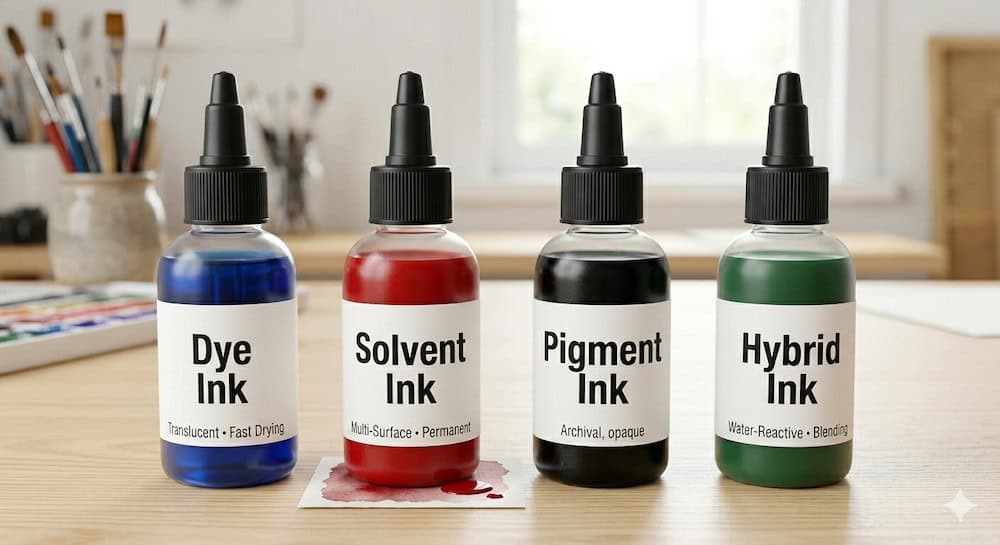
There are a lot of different ink pads out there and they all have their specific use so it’s important you know where you are stamping before buying an ink pad. There are 5 main categories that I want to cover: Dye (Water based and Water-proof), Pigment, Solvent (including fabric), and Hybrid.
1. Water Based Dye Ink Pads
These are your everyday, all-purpose ink pads. Dye inks are the most common and beginner-friendly. This ink tends to soak into the fibers. The particles have fully been dissolved in liquid.
- Behavior: Dries almost instantly. Because it is translucent, it looks like a “stain” on the paper.
- Best For: Standard card stock or paper (not coated), can also be used on skin (with non toxic inks).
- Pros: Fast drying (no smudging) and very affordable.
- Cons: Not great for dark-colored paper (it will disappear) and will bleed if coloured over.
2. Water-Proof Dye Ink Pads
These are typically oil-based inks This ink sits more on the surface initially, then sets into a permanent, waterproof finish once dry.
- Behavior: Dries slower than dye ink but faster than traditional pigment ink.
- Best For: Paper, cardstock, leather, wood, and some fabrics (when heat set).
- Pros: Waterproof (once dry), fade resistant, doesn’t bleed when coloured over, crisp and detailed impressions, acid-free and designed for long-term use (won’t yellow or fade over time)
- Cons: Slower drying, not good for glossy paper.
3. Pigment Ink Pads
For porous surfaces like paper and fabric and some non-porous surfaces if heat set. Think of pigment ink like a thin paint. Instead of soaking in, it sits on top of the surface. The particles or pigments are suspended in a liquid like water or oil.
- Behavior: It is thick, opaque, and dries very slowly.
- Best For: Can be used for fabric (needs to be heat set). Can also be used for embossing (the wet ink holds onto the powder), stamping on dark paper/cardstock, and getting very crisp, vibrant colors.
- Pros: Can be permanent (depends on the pad). Vivid colors; works on dark surfaces; archival and fade-resistant.
- Cons: Will smudge if you touch it too soon, it is slow drying. On glossy or non-porous paper, it may never dry without a heat tool.
4. Solvent Ink
For non-porous surfaces, these are chemical-based inks where the pigment is suspended in a solvent like oil or alcohol.
- Behavior: Dries very quickly through evaporation. It has a distinct “chemical” smell.
- Best For: Non-porous surfaces like glass, metal, plastic, glossy photos, and ceramic.
- Pros: Permanent and waterproof. It’s the only reliable way to stamp on slick surfaces.
- Cons: Can stain your stamps permanently and can be harsh on clear photopolymer stamps if not cleaned immediately with a specific solvent cleaner. Will bleed if coloured over with alcohol based inks. Not used for embossing.
Fabric Inks (Solvent)
This specialty sub-category is specifically talking about the fabric ink we sell in our shop. It is a permanent, solvent-based ink designed specifically for textiles. It absorbs into fabric and becomes wash-resistant, making it ideal for stamping clothing, labels, and tote bags.
- Behavior: Absorbs into fabric quickly and dries relatively fast.
- Best For: Fabric items like tote bags, clothing labels, and textile packaging.
- Pros: Wash Resistant. Does not require heat setting.
- Cons: Limited colour range, not ideal for super fine details on textured fabrics.
5. Hybrid Inks
These are modern “fusion” inks that try to offer the best of both worlds (Dye + Pigment).
- Behavior: They are more opaque than dye ink but dry faster than pigment ink (but not as vibrant as pigment).
- Best For: Mixed media, blending backgrounds, and stamping on various paper textures. Works on more surfaces than dye ink pad.
- Pros: Excellent for blending colors together; works well on both light and dark cardstock.
- Cons: Can be more expensive than basic dye pads.
Quick Guide: Which Ink Should You Use?
- Paper & boxes → Dye
- Dark paper → Pigment
- Glossy / plastic / metal → Solvent
- Multiple packaging materials → Hybrid
- Fabric → Fabric ink (or a heat set pigment ink)